
27 March 2026
Recent events in global energy markets are once again reminding Europe that it needs to reduce its dependence on fossil fuels. While it remains unclear how events will unfold in middle east, the risk of significant and sustained rises in especially gas prices, and thus also power prices, is already being priced into European energy markets. Europe remains highly dependent on gas-fired power plant in particular as its main source of power system flexibility when demand rises and wind or solar production slows.
This is a rapidly growing problem for which the EU remains behind schedule: in 2024, about 24% of power generation came from wind and solar. By 2030, that number could be as high as 50%. As long as efforts to scale cheaper, domestically controlled, alternative sources of flexibility have not reached meaningful scale, Europe will not be able to manage this transition without recourse to gas and fossil fuels.
But what does “scaling up flexibility” actually mean in practice? For example, how much flexibility do we need by 2030? Are batteries sufficient or do we also need demand response? How much of each and from which consumers? What are the indicators of success or failure?
With the forthcoming Network Code on Demand Response, new National Flexibility Needs Assessments, as well as recent Commission Guidelines facilitating national Fossil-free Flexibility mechanisms, such questions now require practical answers that must be implemented by member states. Implementation must happen urgently while also reflecting the broader strategic energy needs of the EU and its member states in a time of high prices, energy insecurity and growing strains on legacy grid infrastructure.
Aim
To help answer these questions, Demand Response for Europe commissioned a study from Compass Lexecon. This event presented and discussed the results and recommendations to EU and member state-level stakeholders.
The event featured targeted interventions from the European Commission, ACER, energy think tanks, large energy consumers from industry and digital services, renewable energy associations and demand-response aggregators. The purpose was to highlight key implementation priorities in 2026 with a view to meeting 2030 targets.
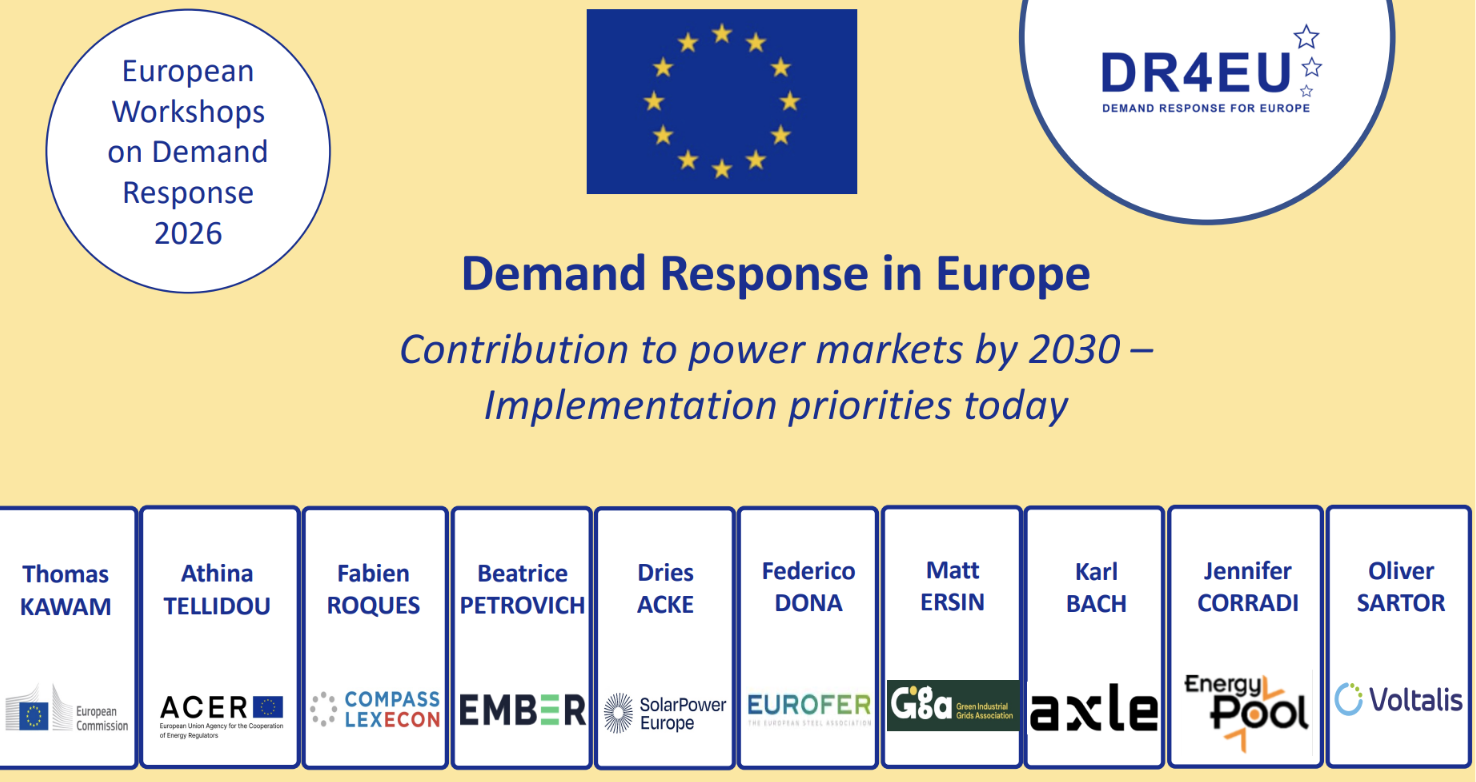
Welcome and Introduction
Jennifer Corradi, Regulatory Affairs Advisor, EnergyPool
Pierre Bivas, Chair, DR4EU
Presentation of the study: “Analysis of Demand-Side Response benefits and needs of the European power system”
Fabien Roques, Executive VP & Head of EU Energy, Compass Lexecon
Implementation Priorities for Demand Response
Thomas Kawam, Policy Officer, DG Ener, European Commission
Athina Tellidou, Policy Officer, Market Codes, ACER
Implementation Priorities for Demand Response
Beatrice Petrovich, Senior Policy Analyst, Ember
Implementation Priorities for Demand Response
Matt Ersin, Chair, Giga & Senior Vice-President Fastned
Implementation Priorities for Demand Response
Oliver Sartor, Chief Economist, Voltalis
Implementation Priorities for Demand Response
Karl Bach, CEO & Co-Founder, Axle Energy
Implementation Priorities for Demand Response
Dries Acke, Deputy CEO, Solar Power Europe
Implementation Priorities for Demand Response
Federico Dona, Policy Assistant to the Director General, Eurofer
Close of meeting
Pierre Bivas, Chair, DR4EU